Four-Point Laser Interferometry.
Based on our experience working with teams developing next-generation non-destructive testing solutions, we recognize that unlocking the full potential of laser-ultrasound technology requires a system that is rugged, multi-point, and highly adaptable—our new platform embodies this vision.
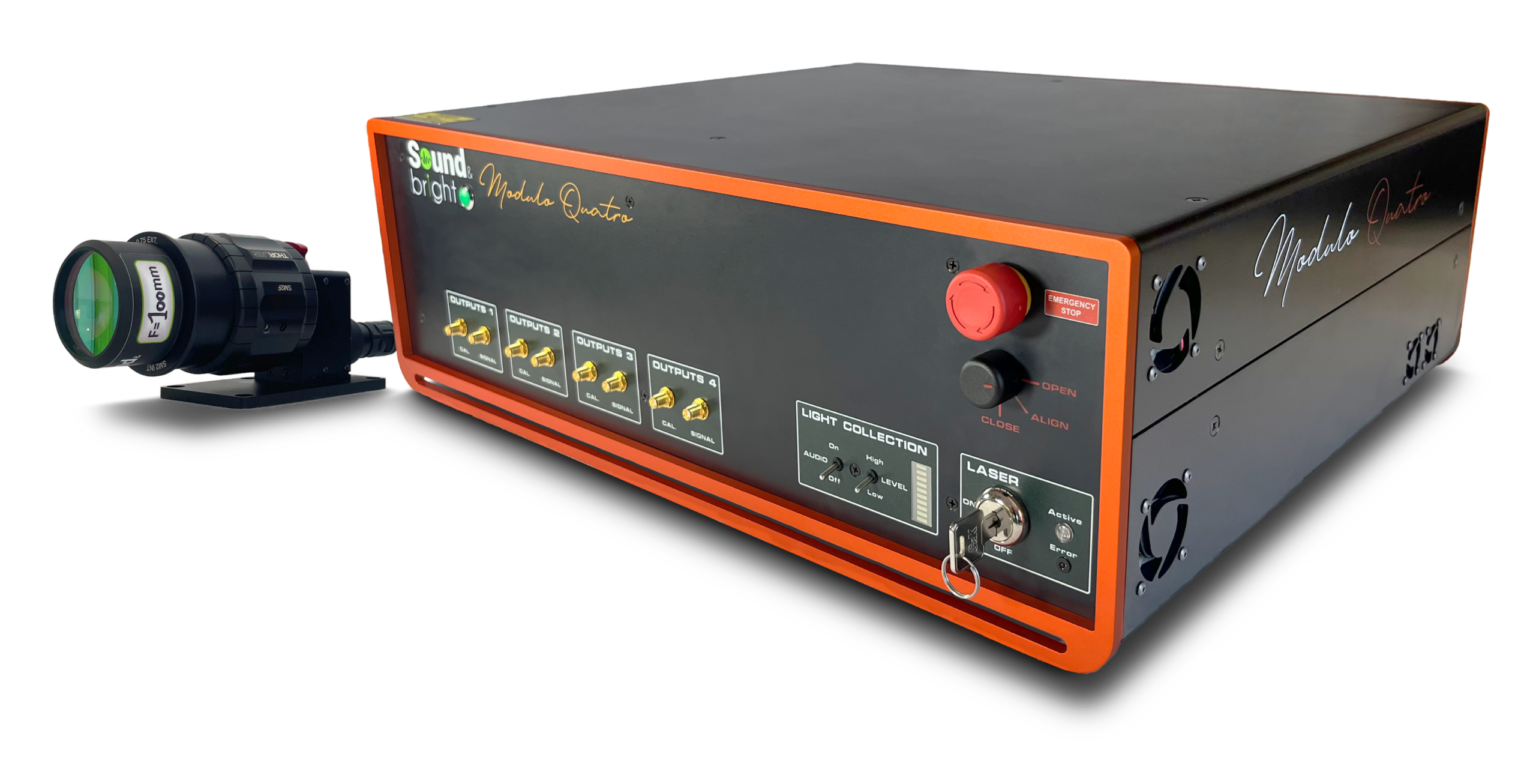
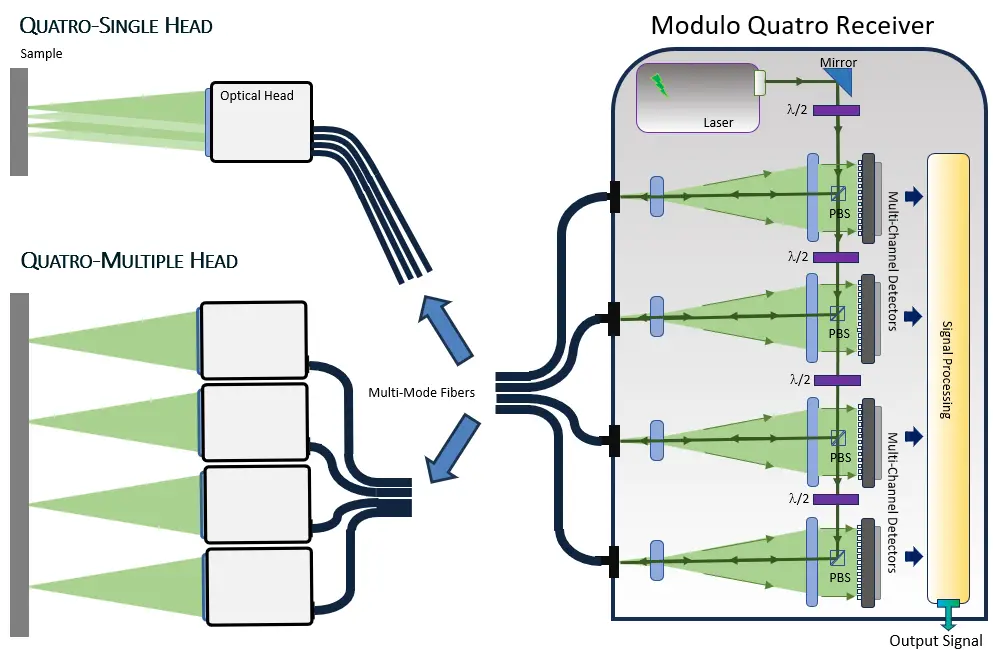
The Modulo Quatro harnesses the advantages of multi-channel random quadrature (MCRQ) technology, creating a versatile, multi-point system designed for advanced non-destructive testing applications. It offers the flexibility to route four detection points through a single optical head for rapid scanning or to utilize four independent optical heads, allowing for simultaneous measurements from various angles on a single point or across multiple widely spaced points on a sample. With the Quatro platform, we can customize your laser interferometer to meet the demands of complex and specific testing scenarios.
Based on a streamlined variant of MCRQ the Quatro features the same benefits as our field-proven Quartet, including a Multi-mode Fiber design for large collection efficiency on any type of surface, detector array and parallel processing for efficient processing of multi-speckled light, and patented signal processing based on our ‘random quadrature’ demodulation scheme.
The Quatro also connects directly to a computer, streamlining the measurement process. No external oscilloscope or A/D card is required, making it a versatile and efficient solution for ultrasonic measurements, maintains precision and ease of use.
FEATURES.
Robust & Versatile
The instrument platform was named Modulo due to the adaptability, or “modulability” of the single detector array design. The Quatro features four measurement channels, each an independent measurement point. It can be built to run multiple closely spaced measurement points through a single optical head, or feature four separate optical heads. Closely spaced measurement points drastically increase scan speeds (x 4) while separate optical heads allow for the measurement of different angles simultaneously, to extract the 3D component. And thanks to our proprietary MCRQ technology, it achieves this without requiring high accuracy optical components or positioning, making it exceptionally rugged.
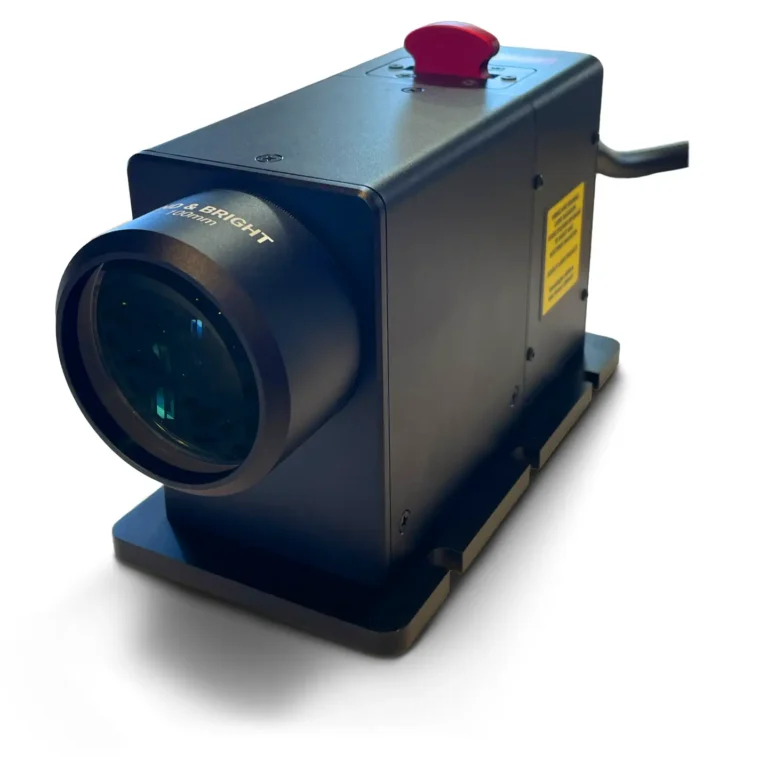
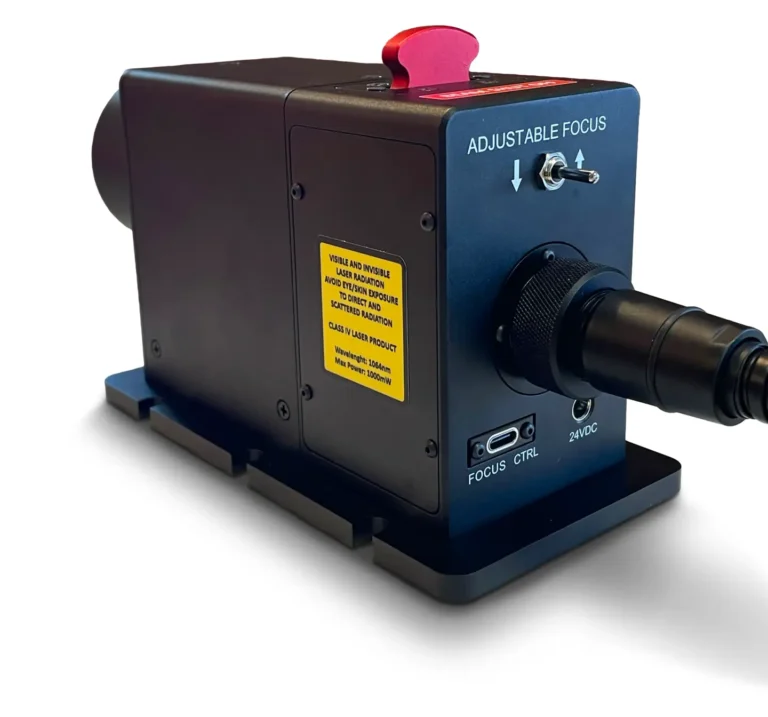
Fiberized Optical Head
A versatile fiberized optical head is easily mounted to fit a variety of measurement conditions and can be set-up for a wide-range of stand-off distances.
Analog & Digital Outputs
The Modulo produces both an analog and digital signal proportional to surface displacement.
High Sensitivity on all Surface Types and Materials
A detector array together with high transmission optics result in high sensitivity. The Modulo produces a stable, demodulated signal even when processing a highly speckled beam. Measurements can be performed on any kind of surface, including rough, porous, rusted and mirror-like.
Rapid Inspection
Efficient electronic processing allows for measurement speeds up to meters per second.
Not Wavelength Dependent
The Modulo can be fitted with a range of internal laser wavelengths ranging from visible to infrared.

Upgrades and Add-ons
Motorized Optical Head
INSERT TEXT
TECHNICAL SPECIFICATIONS.
TECHNOLOGY
Multi Channel Random Quadrature
DETECTION
Out-of-plane and/or 3D
CONFIGURATION
Optical FIber
INTERNAL LASER POWER
400 to 3000mW
DETECTION BANDWITH
Up to 60MHz
DIMENSIONS (L*W*H)
490*450*170 mm
WEIGHT
18Kg
ELECTRICAL REQUIREMENTS
110V/50Hz – 220V/60Hz
TECHNOLOGY.
Based on a streamlined version of our Multi-Channel Random Quadrature technology, the Modulo’s novel optical platform allows us to create a single instrument with as many detection points as needed. In this design, the combined sample and reference beans necessary for interferometry are directed straight onto a single detector array which collects both the vertically and horizontally polarized components, allowing us to us to make an instrument that is remarkably compact per measurement channel, all while remaining both highly sensitive and rugged.
More about MCRQ (Multi Channel Random Quadrature)
Rational
The idea behind Multi-Channel Random Quadrature was to devise a laser-ultrasound technology with a robust, compact design and a large depth-of-field capable of functioning effectively in a wide range of environments without loses in sensitivity, including on rough surfaces. With support from the National Science Foundation and NASA, we developed the Quartet. By collecting and processing a multitude of speckles, the Quartet is fully functional in environments which would otherwise be unsuitable for most other receivers and can perform measurements on all surface types — from mirror-like to rough surfaces.
Multi Channel
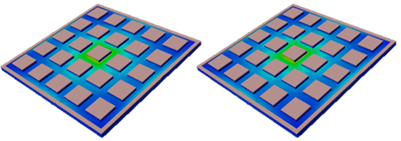
Two detector arrays of 25 elements each allow the Quartet to collect more speckles than a standard receiver, which in turn translates to high sensitivity. To put it another way, employing MCQR technology is equivalent to using 50 Michelson interferometers in parallel.
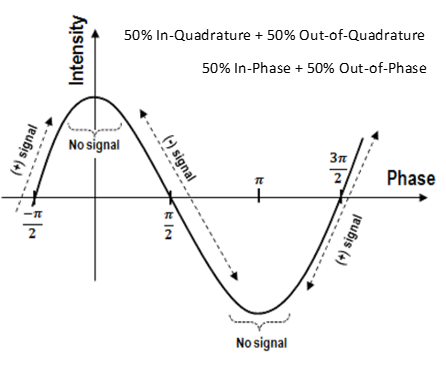
The Quartet does not need to be stabilized as it relies on the random nature of speckles. Statistically, the speckle phase has a uniform distribution, meaning that it is 50% in-quadrature and 50% out-of-quadrature. The out-of-quadrature components don’t contribute to the signal, which is why we use 25 photodiodes on two detectors. Demodulation is required for both the in-phase and out-of-phase signals.
Optical Design
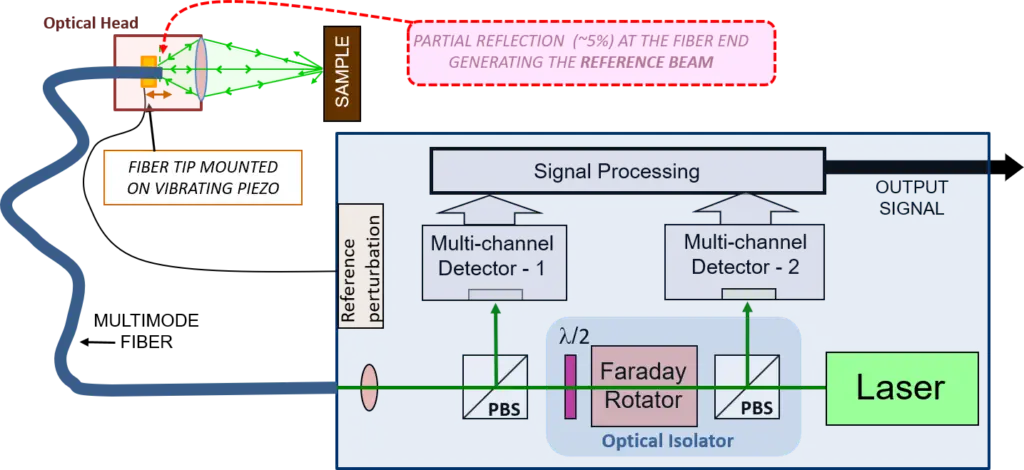
A laser beam generated by the internal laser passes through multiple optics within the receiver before being focused into a multimode fiber. At the end of the fiber, around 4-5% of the light is reflected back towards the receiver due to a natural optical phenomenon while the rest is focused onto the sample. The diffuse light reflected by the sample surface is collected by a large lens located at the front of the optical head, maximizing the quantity of speckles gathered for signal processing. The speckled beam then travels back through the optical fiber, interfering with the 4-5% partial reflection previously mentioned. It is important to note that the light polarization components are scrambled while traveling back through the multimode fiber. Once back in the system, the beam travels through a first Polarized Beam Splitter (PBS) which isolates the vertical polarization component and is in turn directed towards one of the two detector arrays. The rest of the beam travels through an Optical Isolator, which consists of a Faraday rotator and a PBS. This second PBS then sends the vertical (previously horizontal) component of the returning signal-beam back towards the second Multi-Channel Detector. Every signal from the photodiodes will be processed in parallel by an electronic demodulation.
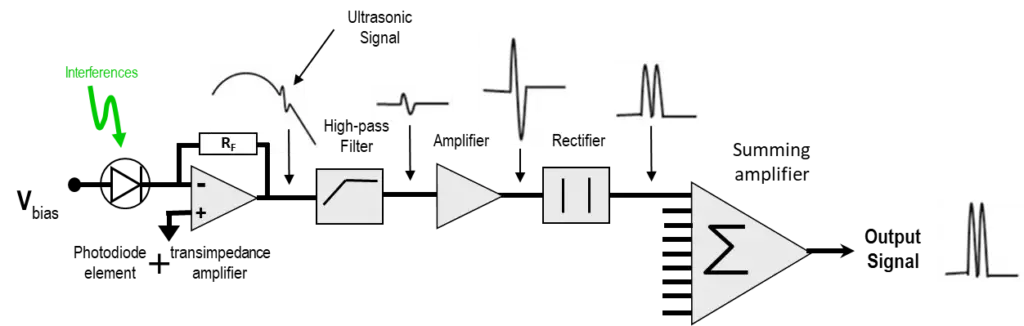
Rectified Demodulation
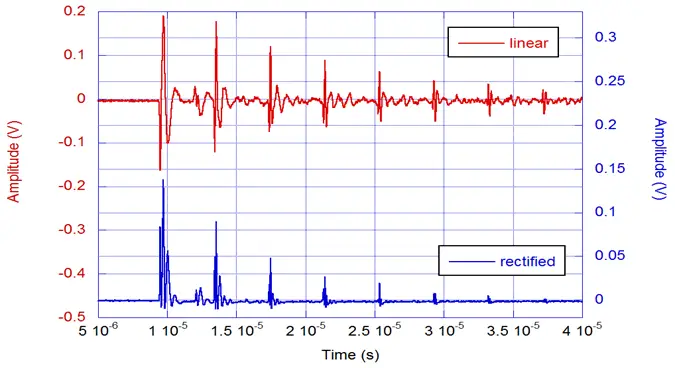
Because of the random nature of the phase of each of the 50 signals detected, the quartet is designed to perform signal rectification without consideration of phase. The streamlined electronic processing allows the Quartet to perform single shot measurements on fast-moving objects. Rectified Demodulation is also effective at rejection of background noise vibration.
Rectified Demodulation alone has a few downsides: it has a high-frequency and small-displacement limitation, and the direction of displacement is unknown. Therefore, the Quartet also uses Linear Demodulation.
Linear Demodulation
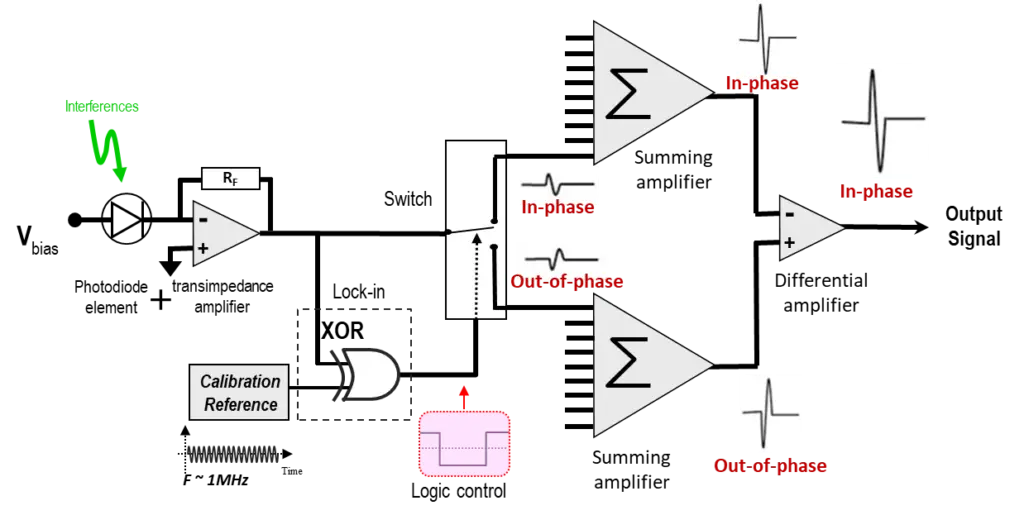
Linear Demodulation is a similarly compact multi-channel architecture, but with a demodulation scheme that yields an output signal proportional to the wave-displacement. It is composed of a transimpedance followed by a logic control which detects the signal phase and switches between two summing amplifiers: one receives the in-phase and the other the out-of-phase signals. Lastly, both phases of the signal pass through a differential amplifier.
PATENTS.
Patent US7978341
Multi-channel laser interferometric method and apparatus for detection of ultrasonic motion from a surface.